
The project team, led by Work Package 2 (WP2) leader Public Open University Čakovec, recently created a list of learning outcomes following a thorough analysis of the European Digital Competence Framework for Citizens (DigComp 3.0). The team selected these outcomes and clustered them into 10 thematic fields that reflect the core aspects of the future curriculum and the upcoming MOOC. It was then time for external evaluators to review the selections, helping the project team refine the learning outcomes for the two main project results.
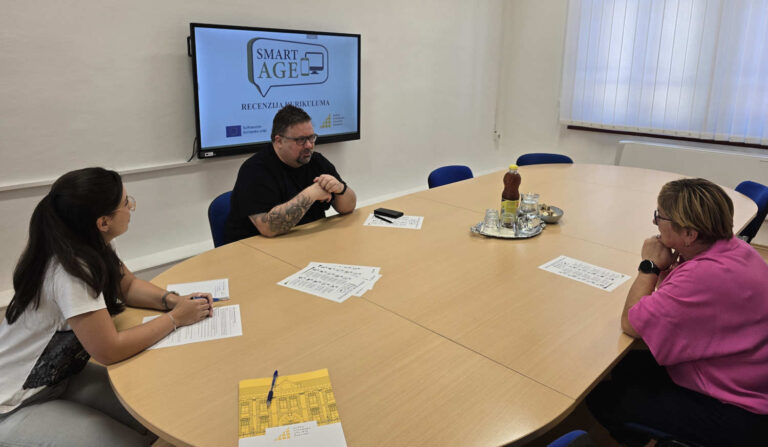
The external review was conducted during February and March 2026 as part of WP2. This acted as a quality assurance step to guarantee the relevance and effectiveness of the selected learning outcomes and the future curriculum. The analysis is based on 12 external reviews submitted by experts from a broad range of relevant fields, including adult education, media literacy, digital education, social work, arts and culture, library and information science, and direct work with seniors. Reviewers also represented a diverse geographical spread across European and regional contexts: Austria, Belgium, Croatia, Finland, France, Germany, Portugal, Serbia, Slovenia, and Spain. This contributed to a credible and multi-perspective review process.
The review also generated valuable developmental feedback. The most frequent recommendations concerned the need to simplify language, reduce conceptual density, use more concrete and recognizable examples from everyday digital life, ensure careful pacing, and strengthen the measurability of some outcomes for future micro-credentialing. Reviewers repeatedly stressed that the future MOOC should be designed as a supportive and confidence-building learning environment, not simply as a content repository. Suggested design implications include short and clearly structured units, intuitive navigation, visual support, guided reflection, and some form of tutor, moderator, or peer support. These comments do not challenge the strategic direction of the framework; rather, they provide practical guidance for its translation into a senior-sensitive curriculum and MOOC.
The project application and amended Annex designated external peer review as a mechanism to validate the adapted outcomes. It set a target that at least 60% of experts should assess the framework and curriculum as “good” or “appropriate,” with a minimum of four expert reviews required. This threshold was clearly surpassed. The review involved 12 experts, all of whom approved the framework overall. In addition, all reviewers considered it a strong basis for the future online course, and 91.7% confirmed its appropriateness for the senior target group. The review therefore fulfilled both of its intended purposes: it validated the framework’s quality and produced concrete recommendations for refinement in the next stages of curriculum and MOOC development.
Stay tuned for more!