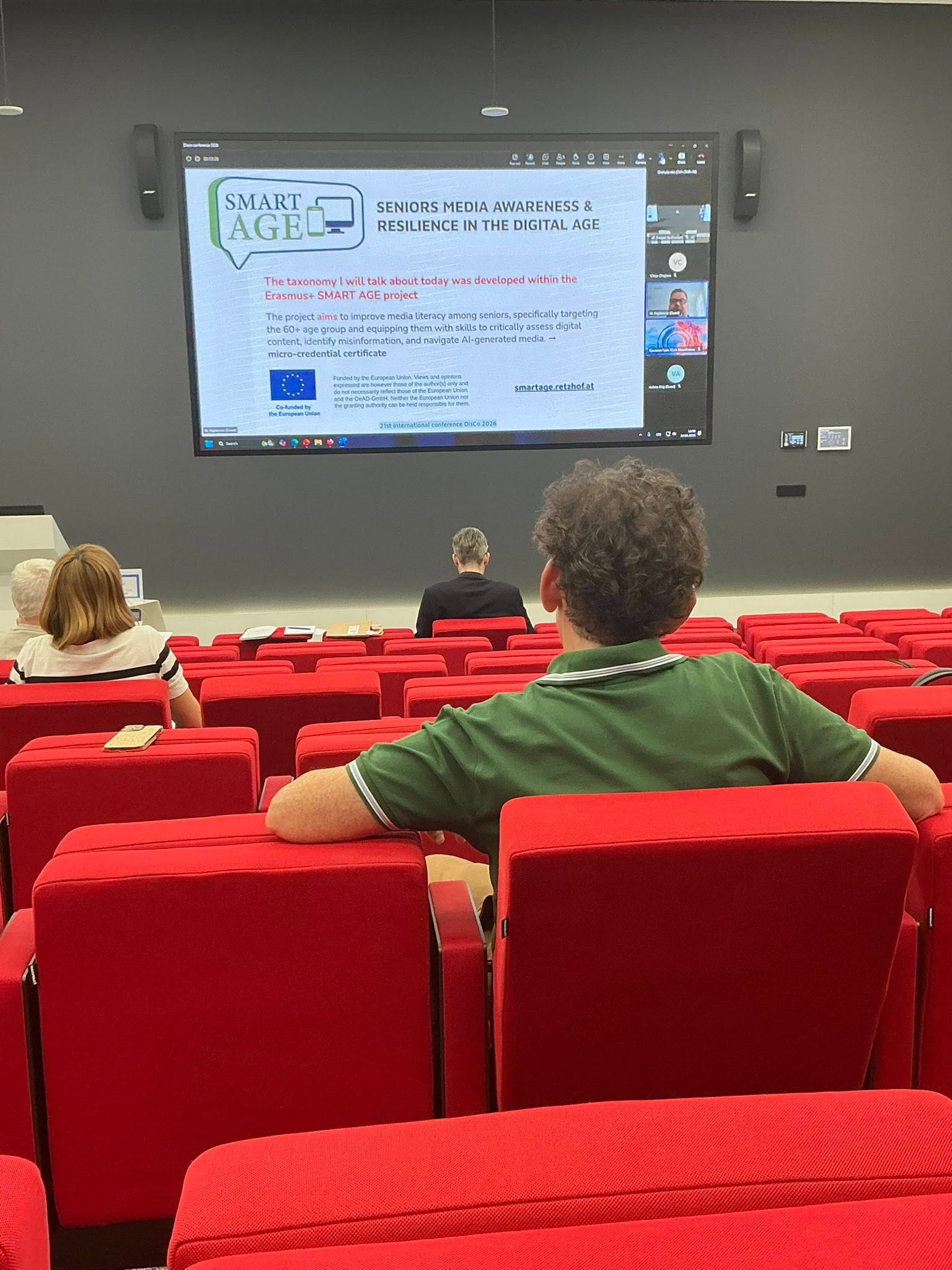
The SMART AGE project was represented at the 21st International DisCo Conference by PhD candidate and project associate Miljenko Hajdarović, from the Public Open University Čakovec. The conference, entitled Future-Ready Skills: Cultivating Digital Fluency and Opportunity for Youth, Women, and Displaced Communities, took place in a hybrid format in Prague and online on 24–25 June 2026, organised by the Centre for Higher Education Studies and the University of West Bohemia in Pilsen.
In his online presentation, From DigComp to Digital Resilience: Designing an Experience-Driven Media Literacy Curriculum for Older Adults, Hajdarović examined how European digital competence frameworks can be translated into meaningful learning experiences for older adults. He argued that competence frameworks are necessary for defining what people should know and be able to do, but that they do not, by themselves, provide an adequate pedagogical approach for senior education.
The presentation introduced work developed within the Erasmus+ SMART AGE project, which aims to strengthen media literacy and digital resilience among adults aged 60 and above. The project adapts DigComp 3.0 into ten age-sensitive learning clusters covering information and media literacy, disinformation, AI-generated content, algorithmic awareness, online scams, privacy, digital well-being, responsible sharing, civic participation and reflective digital autonomy.
A central element of the presentation was the Experience-Driven Media–Digital Taxonomy. The model connects DigComp 3.0, UNESCO’s media and information literacy approach and geragogy, treating older adults’ knowledge, memories and life experiences as important learning resources. Its learning progression moves from experience and recognition through comparison, interpretation and judgement towards purposeful action and the transfer of knowledge into new digital situations.
Hajdarović also presented the results of an external review involving 12 experts from eight European countries (Austria, Belgium, Croatia, Finland, Germany, Serbia, Slovenia, and Spain). The reviewers positively assessed the framework’s alignment with relevant standards, the importance of its topics and its suitability for curriculum and online course development. Their recommendations – including simpler language, more everyday examples and clearer assessment criteria – will be incorporated into the further development of the SMART AGE curriculum.
The presentation emphasised that digital literacy for older adults should not be limited to learning how to operate particular tools. In an environment increasingly shaped by artificial intelligence, algorithmic platforms, misinformation and online risks, education must also develop interpretation, informed judgement, responsible action and long-term digital autonomy.
The fully completed SMART AGE curriculum will be available shortly.